Understanding Jadeite
Or at least know what you’re buying
What Does “种水” Really Mean?
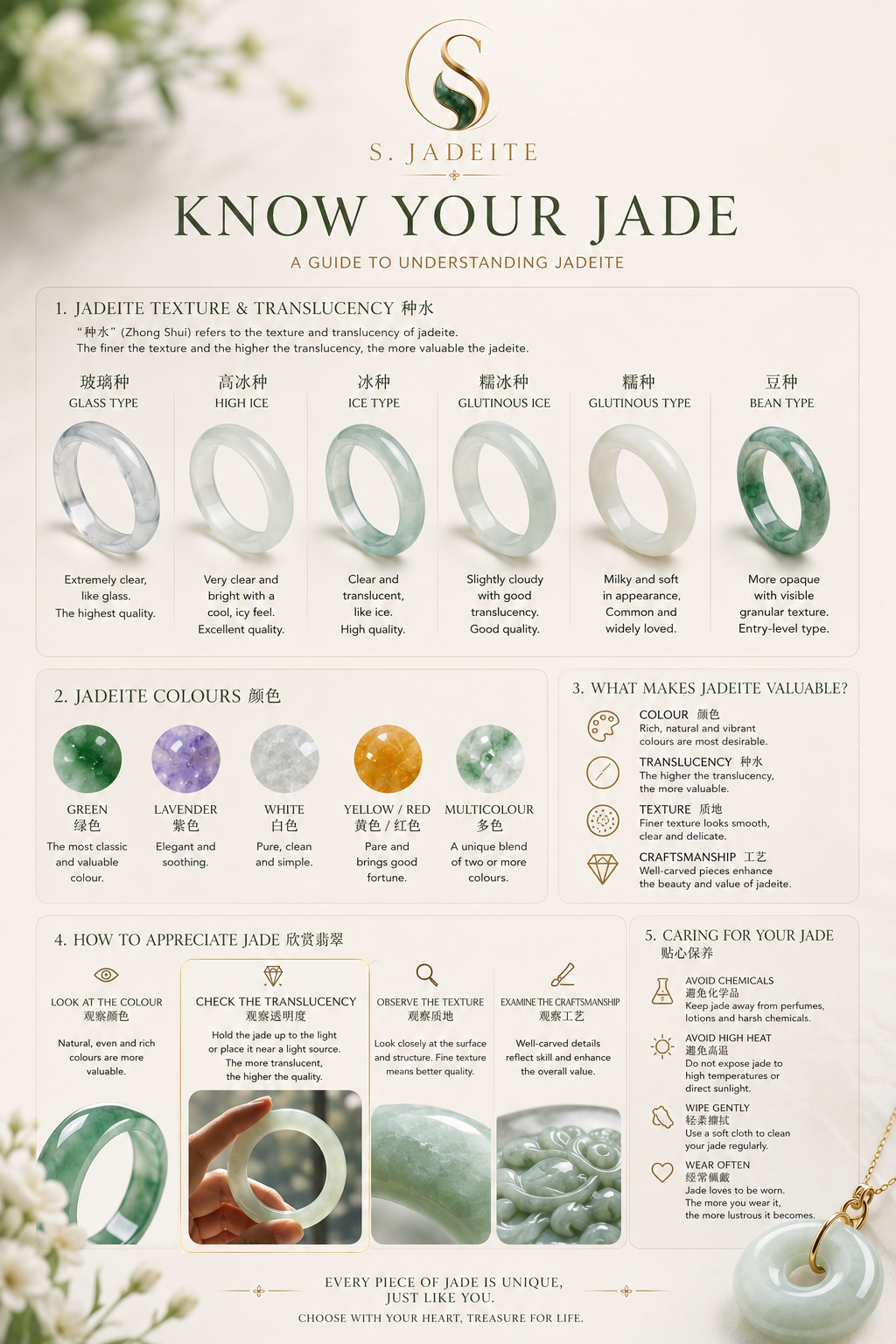
“种水” (Zhǒng Shuǐ) is one of the most common terms used when describing jadeite, but it is actually a combination of two qualities.
种 (Zhǒng) refers to the fineness and compactness of the jadeite’s crystal structure. When the crystals are finer and more tightly packed, the jadeite tends to look smoother, more delicate and refined.
水 (Shuǐ) refers to translucency and the way light travels through the stone. Jadeite with good 水 often has a luminous, lively appearance rather than looking flat or dull.
Although 种 and 水 are closely related, they are not exactly the same thing. A piece can have a fine texture without being extremely transparent.
Is More Transparent Jadeite Always Better?
Not necessarily.
High translucency is desirable and can significantly affect value, but transparency alone does not determine whether a piece of jadeite is good.
Two bangles of the same 冰种, for example, can have very different values depending on their colour, texture, clarity, flaws, proportions and overall appearance.
This is why jadeite should always be assessed as a whole rather than simply by its 种水.
How to Tell 棉, 石纹 and 裂 Apart:
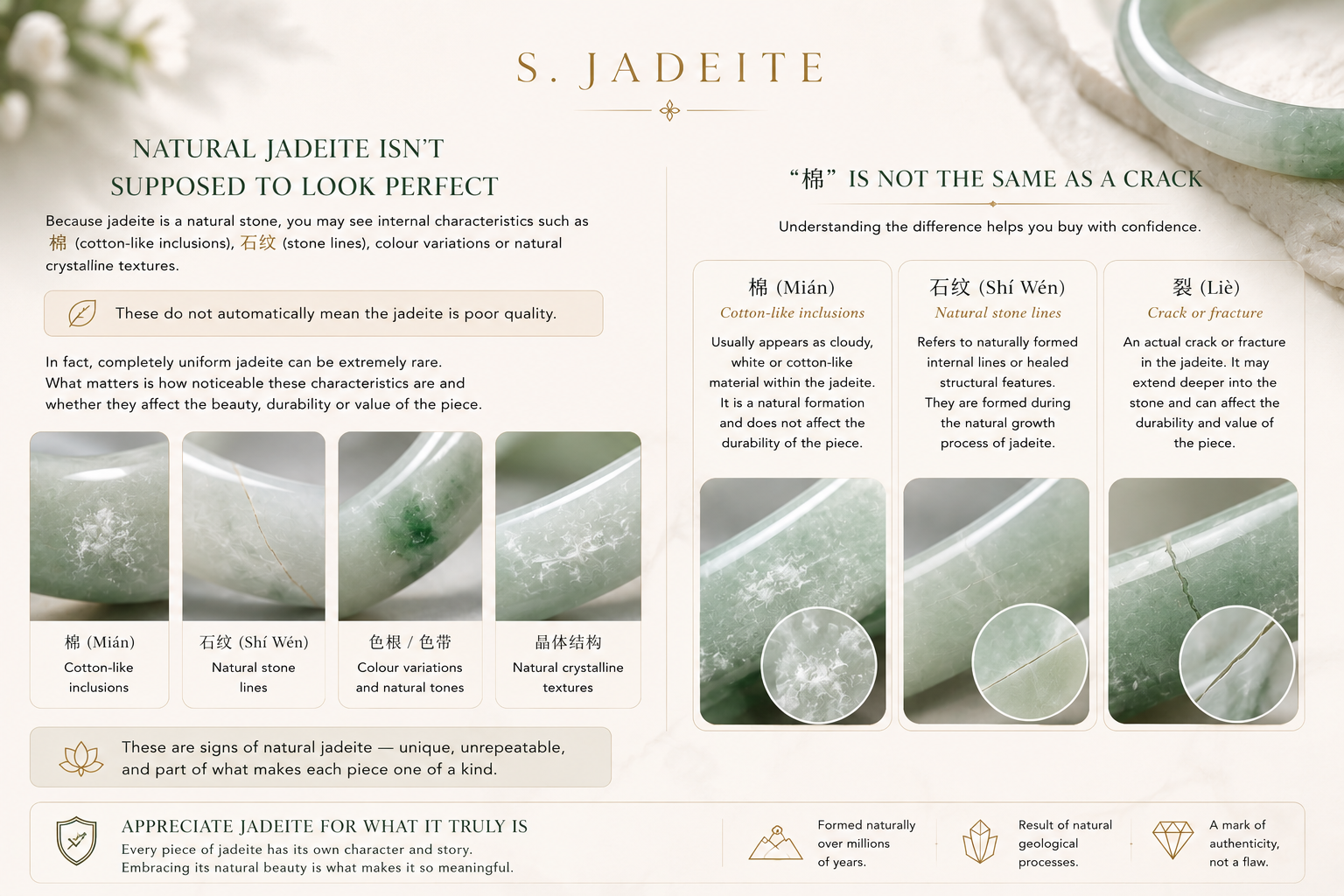
棉 (Mián) — Cotton-like inclusions
棉 usually appears as soft white, cloudy, misty or cotton-like areas inside the jadeite. It is part of the stone’s natural internal structure and is extremely common in natural jadeite. The amount and position of 棉 matter. A small amount may have little impact on the overall beauty of a piece, while heavier or more obvious 棉 can reduce its translucency and visual clarity. Interestingly, some natural internal textures can even contribute to the individual character of a piece.
石纹 (Shí Wén) — Natural stone lines
石纹 can look like a fine line running through the jadeite, which is why it is sometimes mistaken for a crack. However, 石纹 is generally an internal structural feature rather than an open fracture. Think of it almost like a “healed” line within the stone. A useful visual clue is that a 石纹 may be visible under light but usually does not create an obvious open gap on the surface. Its effect on value depends on how prominent it is, where it is located and the overall quality of the jadeite.
裂 (Liè) — Crack or fracture
裂 deserves more attention when purchasing jadeite because it represents an actual fracture in the stone. Unlike 石纹, a crack may extend to the surface and can sometimes be felt with a fingernail when gently passed across the area. Cracks can affect both durability and value, particularly in bangles where the jadeite is subjected to everyday knocks and pressure.
A Simple Way to Remember
棉 → looks cloudy
石纹 → looks like a line, but is part of the stone’s internal structure
裂 → an actual fracture that may compromise the stone
Understanding Jadeite Treatment
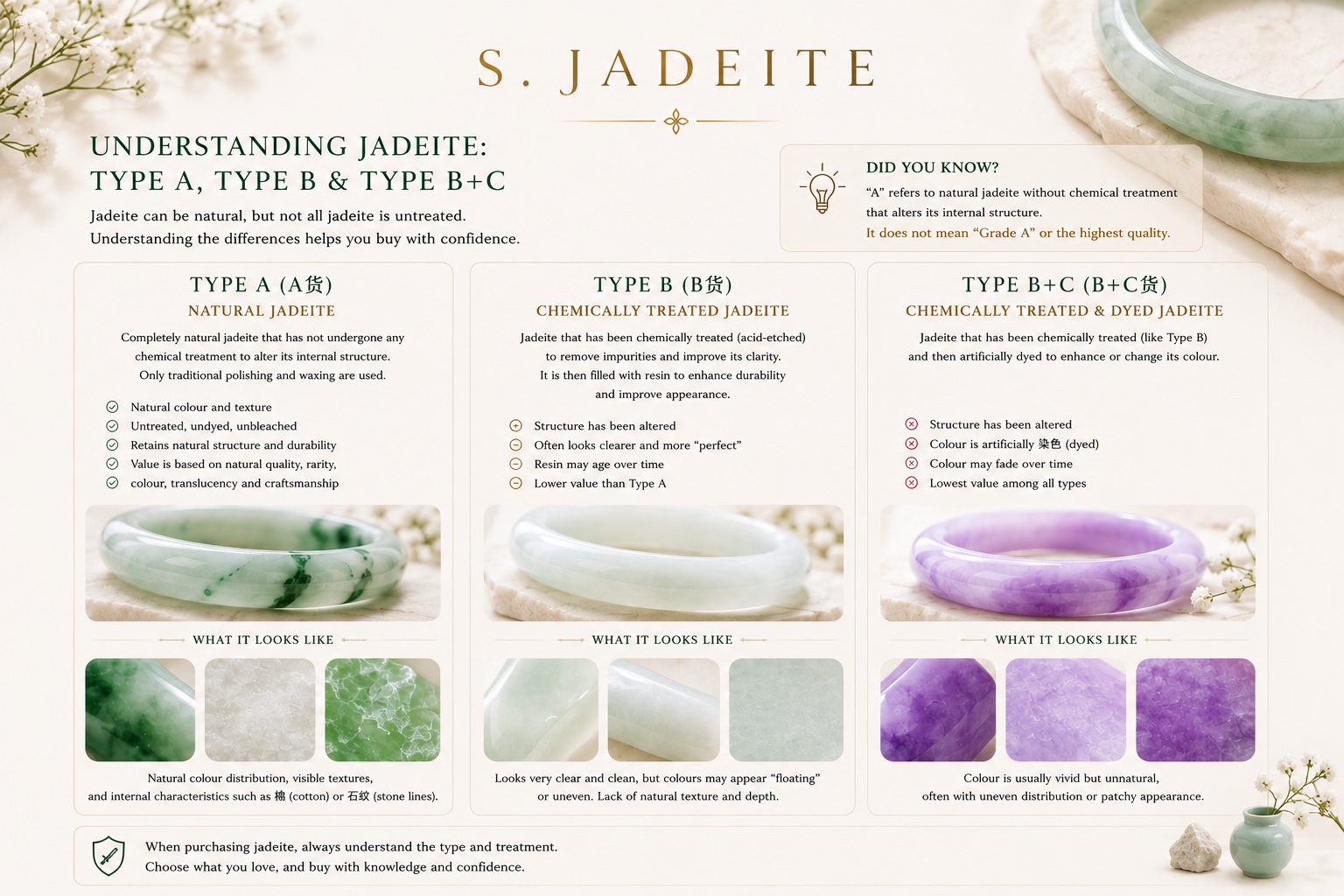
Type A (A货) is natural jadeite that has not been chemically treated to alter its internal structure or artificially dyed. Traditional finishing such as polishing and waxing may be used. This is the type of jadeite we offer at S. JADEITE.
Type B (B货) jadeite has been chemically treated, typically to remove impurities or staining, and then impregnated with polymer/resin. This can make the jadeite appear cleaner or more translucent, but its natural structure has been altered.
Type B+C (B+C货) undergoes similar treatment to Type B, with the addition of artificial dye to enhance or change its colour.
In simple terms:
A = Natural
B = Treated
B+C = Treated + Dyed
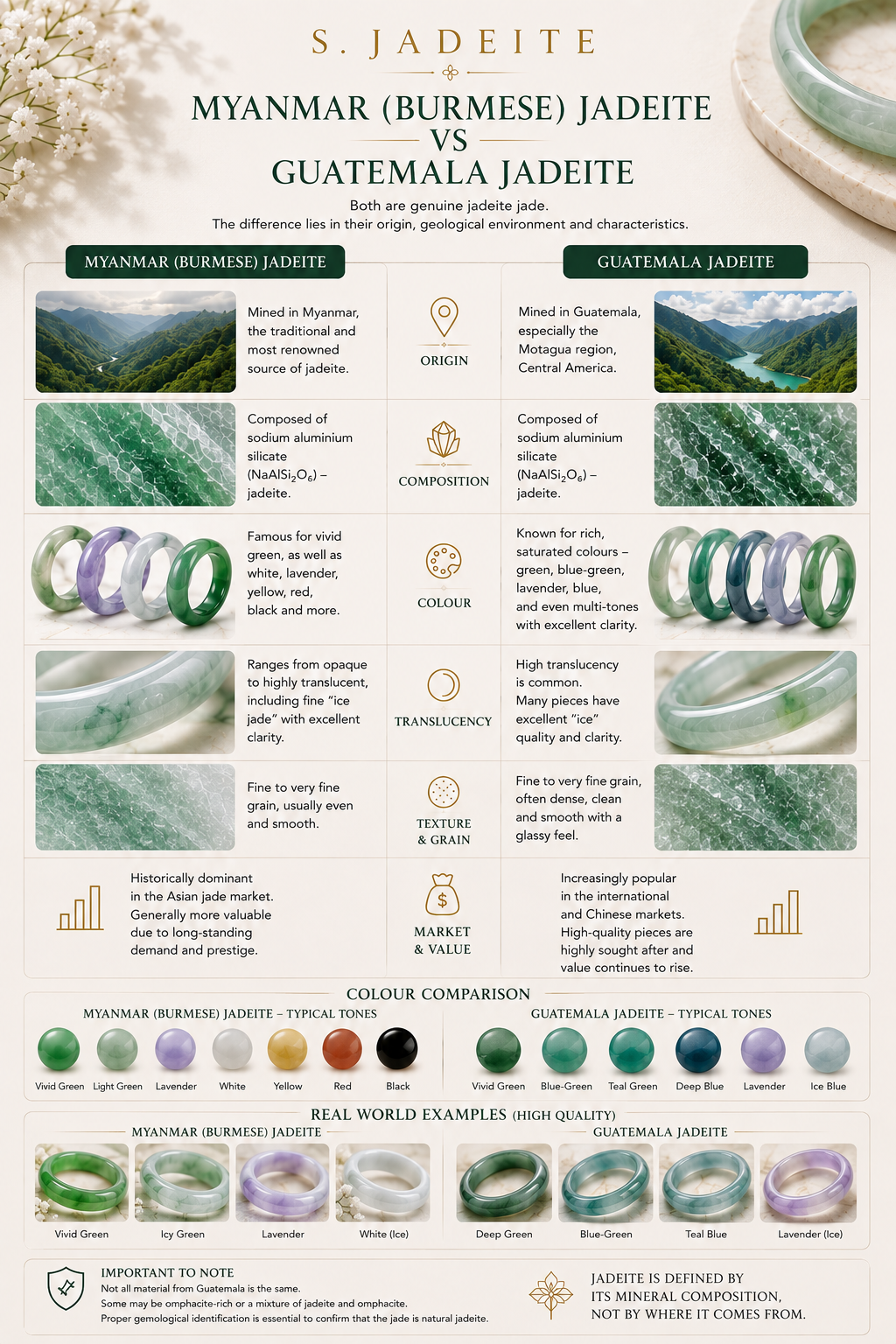
For generations, Myanmar has been the best-known source of jadeite, particularly within the Chinese and Southeast Asian jade market. Its long history and association with exceptional Imperial green jadeite have made “Burmese jade” synonymous with fine jade for many collectors.
But Myanmar is not the only place where jadeite is found.
Guatemala is another important source of jadeite, with deposits associated with the Motagua region. Guatemalan jadeite can display its own distinctive character, including rich greens, blue-greens, darker tones and, in fine material, beautiful translucency. The country of origin does not by itself determine whether a piece is “good” jadeite. Colour, texture, translucency, internal characteristics, treatment status and craftsmanship all need to be considered together.
Why S. JADEITE Offers Both
At S. JADEITE, we appreciate jadeite for the individual beauty of the stone — not simply the country written beside its name.
Our collection may therefore include carefully selected jadeite from both Myanmar and Guatemala. Some customers may prefer the classic appearance and heritage associated with Burmese jadeite, while others may be drawn to the deeper greens, blue-greens and distinctive character often seen in Guatemalan material. Neither should be disguised as the other.
Our Promise: 100% Transparency
When a piece is represented to us and sold as Guatemalan jadeite, we will clearly identify it as Guatemalan jadeite in its product description. Likewise, we will not intentionally market Guatemalan material as “Burmese” simply because Burmese jadeite may command greater recognition in the market.